
As digital wholesale ecosystems mature, marketplaces must constantly innovate to unlock fresh revenue streams for their listing brands. A major development in this evolution is the formal introduction of a brand-new customer classification on Faire: Business-Use Buyers.
For established consumer product brands, this feature represents a massive strategic shift in how you look at B2B distribution. However, whenever a major platform alters its buyer profile rules, it naturally triggers questions around margin protection, operational control, and tax compliance.
At Sona Wholesale Consulting, we analyze new platform mechanics through a strict, numbers-first operational lens. To help you determine whether this feature is an asset or a risk for your corporate growth, here is an honest, comprehensive guide to understanding business-use buyers, why this update is a massive win for your bottom line, and how to locate and configure these parameters in your dashboard settings.
Understanding the Corporate Profile: Who Is a Business-Use Buyer on Faire?

To manage these accounts successfully, you must first understand their commercial intent. Business-use buyers are verified corporate entities purchasing products for their own internal operations or commercial environments, not for retail resale.
These are real-world businesses such as boutique hotels, independent restaurants, cafes, and corporate buyers purchasing high-quality items specifically for their own use. They purchase your items in bulk at standard wholesale pricing, meet your exact minimum order thresholds, and use your inventory in their daily operations, corporate events, or client gift boxes rather than selling them individually to end consumers.
Common real-world examples include hospitality groups stocking luxury guest rooms and welcome trays, restaurants and cafes sourcing custom table linens or specialty condiments, and wellness studios buying treatment room essentials and skincare supplies. You will also see corporate buyers purchasing bulk goods for internal client appreciation initiatives or large-scale community gatherings.
Why This Update is an Incredible Growth Opportunity for Brands

While introducing a non-retail buyer class might make some traditional operators hesitant, this feature is actually a massive competitive advantage for product brands.
Centralizing this corporate demand unlocks several unique financial and logistical benefits:
Massive Incremental Order Volume: This update opens your brand up to entirely new, untapped B2B market verticals. Instead of relying solely on independent gift boutiques, you can now seamlessly capture bulk orders from hotels, restaurants, and corporate buyers that have massive operational budgets and require consistent quantities of premium products.
Higher Reorder Rates & Predictable Consumption: Retail boutiques buy inventory based on shifting seasonal styles and unpredictable consumer shopping trends. Business-use buyers, however, consume your products as a function of their daily operations. A hotel will always need more soap; a corporate office will always need more client gifts. This operational consumption translates into highly predictable, automated reorder cycles that stabilize your production cash flow.
Zero Territory Conflicts with Your Existing Stockists: One of the biggest headaches in wholesale is managing "radius protection" or zip-code exclusivity requests from competing boutique stores. Because business-use buyers are consuming your products internally rather than putting them up for sale on a public shelf, you can comfortably sell to a hotel or restaurant located directly next door to one of your primary retail stockists without triggering a territory conflict.
Streamlined Centralized Demand: Many premium brands were already manually processing custom bulk orders for local corporate clients off-platform. By welcoming these business-use buyers into a structured portal, you can route all corporate procurement through a single dashboard, leveraging the platform's automated shipping label generation and payout tracking to save your team hours of administrative tracking.
Faire Dashboard Walkthrough: Where to Find and Control This Option
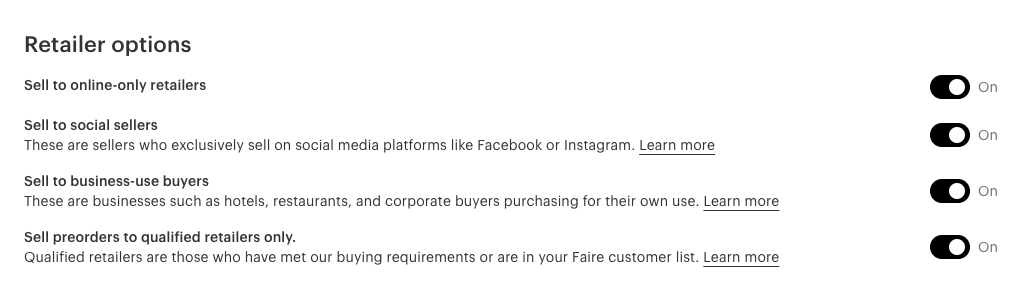
Even with these massive benefits, the platform recognizes that you must maintain full operational control over your brand positioning. You are given complete, absolute authority over whether you want to open your catalog to these corporate entities or keep your distribution strictly limited to traditional retail stores.
Brands can easily find this option by navigating through their backend dashboard menu.
First, log into your account, go to your Account Settings, and select Shop Settings. From there, scroll down until you reach the Retailer Options section. Here, you will see a dedicated control switch titled Sell to business-use buyers which you can toggle on or off depending on your preference. Simply click Save, and please note that it can take up to 24 hours for the platform's system to fully apply the update across your public listings.
If you keep the toggle on, you still retain individual order control. When you receive a new order notification, you can review the buyer's profile by clicking “Learn about this retailer” under the New Customer! tag. If a specific hotel or restaurant isn't a good fit, you can decline the transaction. Choosing to reject a business-use order will have zero negative impact on your Top Shop canceled order metric.
Commercial Rules: Pricing, Verification, and Tax Compliance

From a pure margin perspective, the platform enforces your existing rules across the board. Business-use buyers do not receive special discounts or lower pricing; your standard tier pricing and minimum order quantities (MOQs) apply to them exactly like a traditional boutique.
To maintain platform legitimacy, all business-use entities undergo a thorough corporate verification process. Because they are the final end-users of the products rather than resellers, they are not required to input a traditional reseller tax ID, but the platform validates their commercial status using clear business signals so you can ship your orders with absolute peace of mind.
From a tax perspective, the marketplace handles the administrative heavy lifting. For all orders shipping to a United States address, marketplace facilitator tax rules require the platform to collect and remit state and local sales and use taxes directly on your behalf.
While your accounting team may need to report these marketplace transactions on your corporate sales tax returns and claim them as a standard deduction to prevent double-taxation, your direct administrative burden remains minimal. For shipments traveling outside the United States, standard international tax compliance protocols like VAT or GST apply normally based on the destination country and order value.
How Sona Optimizes Your Marketplace Strategy
You do not have to guess your way through platform updates or leave new B2B revenue opportunities on the table. At Sona Wholesale Consulting, we help our clients maximize this new corporate demand while maintaining strict brand boundaries:
We audit your storefront configurations to ensure your business-use toggles align perfectly with your broader retail distribution agreements.
We mathematically optimize your tier pricing and bulk MOQs to ensure large-scale corporate orders yield maximum profitability.
We structure your product descriptions and backend tags to capture both high-volume retail buyers and lucrative corporate accounts.
We manage your end-to-end account health, ensuring your operational metrics remain flawless as your order volume scales.
Turn Platform Updates Into Compounding Revenue
The wholesale landscape is expanding far beyond traditional retail store shelves. By understanding how to safely leverage new buyer segments like business-use corporations, your brand can capture highly profitable, incremental bulk orders without disrupting your core boutique relationships.
Discover how we help independent brands navigate platform changes and build scalable, highly optimized B2B operations by visiting our case studies page, and see what our corporate partners say about our method by reading our verified client testimonials.
Let's look over your account settings, optimize your catalog for corporate demand, and scale your wholesale revenue together.
📞 Click Here to Book Your 1-on-1 Discovery Call
Let’s audit your marketplace portal configurations and determine the most profitable buyer strategy for your product brand.
