
The era of "passive wholesale", simply listing a catalog and waiting for retailers to find it is officially over. As we enter 2026, the gap between brands that grow and brands that struggle is being defined by Infrastructure.
From the rise of AI-driven procurement to the operational strain of multichannel expansion, success in the 2026 B2B landscape requires a strategic shift. At Sona Wholesale Consulting, we’ve identified the three structural pillars every brand must master to scale from independent boutiques to national retailers.
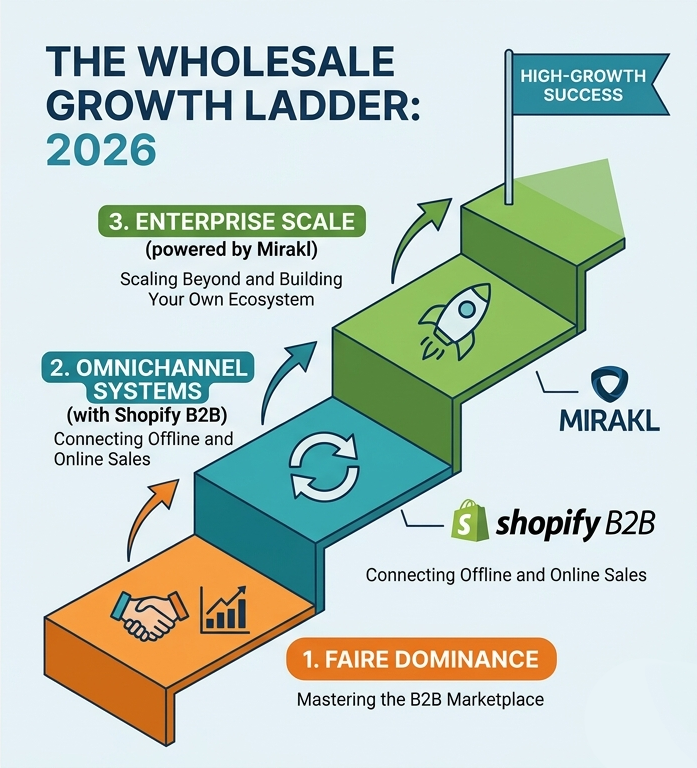
1. Agentic Commerce: How AI is Reshaping B2B Discovery
The "search and scroll" era of wholesale marketplaces is being replaced by "Ask and Act." Retail buyers and procurement managers are increasingly using AI agents to source products, compare wholesale margins, and vet brand reliability.
Research shows that AI referral traffic to eCommerce sites grew twelve times in just seven months. For B2B, this means buyers aren't just browsing Faire or Mirakl; they are asking LLMs to "Find me sustainable home decor brands with a 50% margin and a 24-hour lead time."
The B2B Reality: If your product data isn't structured for Generative Engine Optimization (GEO), your brand is invisible to the most qualified buyers in the market.
The Strategy: Brands must move beyond basic keywords. Winning in 2026 requires high-fidelity product data that AI can "read" and recommend. Those who optimize early will capture organic wholesale leads without the soaring costs of B2B ad spend.
2. From "Being Everywhere" to "Profitable Omnichannel"
B2B marketplaces are growing at nearly four times the rate of traditional eCommerce, now accounting for 67% of all online sales. But for a brand to scale, multichannel expansion must be a profitability imperative, not just a growth lever.
We are seeing a massive shift where professional buyers prefer specialized marketplaces over generic platforms. They want the curation of Faire for boutique discovery and the enterprise reliability of Mirakl-powered retailers (like Macy’s or Nordstrom) for volume.
The Strategy: Strategic channel selection is critical. Every marketplace you join sends a "trust signal" to the AI ecosystem. Curating your inventory by channel and understanding the unique audience behavior of each is the only way to scale sustainably in 2026.
3. Scaling Demands Operational Excellence (The $1.2 Trillion Leak)
Scaling across multiple B2B channels creates hidden operational costs that bleed margins dry. Globally, $1.2 trillion is lost annually to stockouts. In the wholesale world, a stockout isn't just a lost sale, it’s a damaged retailer relationship and a hit to your marketplace ranking.
The problem compounds with every new channel. When your inventory data between Shopify B2B, Faire, and Mirakl is out of sync, even by an hour it leads to oversells, cancelled POs, and "blacklisting" by major retailers.
The Strategy: In 2026, Operational Excellence is your greatest competitive advantage. Avoiding common multichannel mistakes requires real-time synchronization and a "Single Source of Truth" for your inventory. You cannot scale to national retailers with manual data entry.
Future-Proof Your Distribution with Us
Navigating the 2026 landscape means evolving your B2B strategy from "Search" to "AI-Ready." It requires building the resilience to handle enterprise-level volume while protecting the margins of your independent boutique business.
Is your brand 2026-ready? At Sona Wholesale Partners, we build the infrastructure that automates these shifts, from Faire SEO to Mirakl Connect integration.
Book a Free Wholesale Performance Audit to see where your infrastructure is leaking revenue.
